

Key takeaways
- Define a bounded pilot with application, identity, security and support owners.
- Test permitted access, denied access and approved exceptions separately.
- Investigate unreliable signals before weakening the access policy.
- Expand only when business workflows and unresolved risks meet agreed criteria.
Choose a bounded pilot
Zero Trust evaluates access to resources without treating network location or ownership as sufficient evidence of trust. NIST SP 800-207 explains that resource access depends on authentication and authorisation, rather than implicit trust in the surrounding network.
For the broader concept, see what Zero Trust security means. The implementation decision here is narrower: select a resource whose important workflows can be described, tested and supported during a controlled rollout.
An illustrative pilot charter, not an ACT deployment record, might look like this:
| Charter item | Example decision |
|---|---|
| Protected resource | Finance reporting application; viewing reports only |
| User group | A defined finance team and one controlled supplier role |
| Business owner | Finance reporting owner approves essential workflows |
| Technical owners | Identity lead, endpoint lead and application administrator |
| Operating owner | Support lead receives access incidents and coordinates escalation |
| Expansion condition | Required workflows pass; access decisions are traceable; critical exceptions are resolved or explicitly accepted |
| Pause condition | An essential workflow is blocked without an approved alternative, or decision signals cannot be trusted |
Choose a useful pilot rather than an artificially simple demonstration. Include representative access paths, but avoid turning the first phase into a replacement of every application and security tool.
Assess identities, devices and access paths
Map employees, supplier accounts, service accounts and machine identities that reach the resource. For each, identify the owner, permitted task, authentication path and existing privileges. Shared accounts and undocumented integrations deserve attention because they make policy decisions harder to explain.
Device posture is evidence about a device’s condition, such as whether it meets the organisation’s management and protection requirements. Define which signals are reliable enough to use, how recent they must be and what happens when they are missing. Do not silently treat an unavailable signal as a passing result.
Record legacy constraints before enforcing changes. An application that cannot use the intended authentication method may need an alternative supported access design or a temporary, owned exception. It should not disappear from the risk register because the pilot dashboard looks healthy.
Translate risk into explicit policies
Write policies as decision statements: a named user class may perform a defined action on a resource when specified conditions are met. Separate the intended decision from how the selected platform implements it.
For example, “finance report readers can view approved reports from compliant managed devices after the required authentication” is testable. “Trust finance users” leaves the action, device condition and privilege boundary undefined.
| Policy dimension | Question to resolve | Owner of the answer |
|---|---|---|
| Identity | Which user or machine may request access? | Identity owner with the business owner |
| Resource and action | Which reports or operations are permitted? | Application and business owners |
| Device condition | What evidence qualifies the device? | Endpoint and security owners |
| Exception | What limited deviation is accepted, and until when? | Named risk owner |
| Emergency access | How is urgent access authorised, recorded and reviewed? | Security and operating owners |
ACT’s enterprise cybersecurity solutions provide a relevant service context for this scope. The pilot still needs its own policies, owners and acceptance record.
Test allowed, denied and exceptional access
The following matrix contains simulated teaching outcomes only. It is an editorial example of recording policy evidence, not a claim about a particular product or a completed customer test.
| Case and starting condition | Expected decision | Simulated observation | Evidence and owner |
|---|---|---|---|
| P01: Approved finance reader; managed device meets the agreed posture; required authentication completes | Allow report viewing; deny administrative actions | Viewing allowed; admin action rejected | Decision log and workflow result; application owner |
| P02: Same reader; device posture is unknown | Deny the protected action and provide the approved support route | Access denied; support can identify the missing signal | Device signal record and access event; endpoint owner |
| P03: Supplier role with an approved, limited report-viewing exception | Allow only the approved resource and period; deny after expiry | Limited access works; the expiry test denies access | Exception approval and before/after decision logs; risk owner |
For P03, the illustrative register sets expiry at the end of pilot day 7. The exception owner must review or remove it before that point; expiry is not permission to renew it automatically. The observed results above are fabricated for explanation and must be replaced by real evidence in an actual deployment.
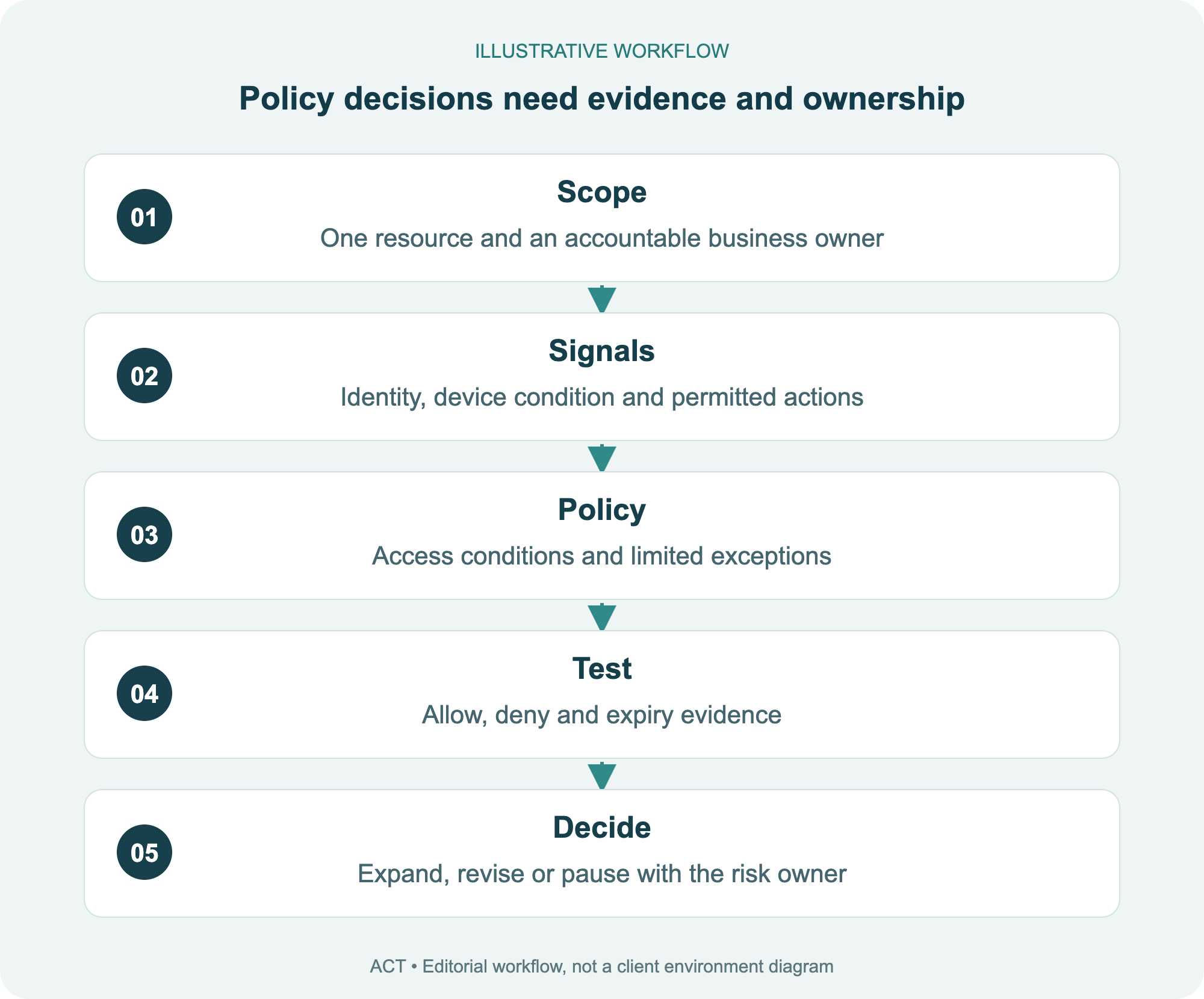
Policy decisions need evidence and ownership.
Run the pilot and investigate disagreements
- Capture the current access behaviour and the essential workflows.
- Agree the policy, its signal sources and its exception rules.
- Use a supported observation or staged rollout approach where available.
- Execute positive, negative and exception tests with authorised test accounts.
- Investigate incorrect decisions with identity, device and application evidence.
- Review business impact, support issues and remaining risks before expanding.
If a legitimate user is blocked, first determine whether the policy is wrong, the device signal is stale or the identity record is incorrect. Relaxing the rule immediately can conceal a data-quality problem and create broader access than intended.
Keep diagnostic records proportional to the investigation. Support needs enough information to correlate an access decision, but should not expose credentials, tokens or unnecessary personal information in tickets or public examples.
Decide whether to expand, revise or pause
| Decision | Evidence supporting it | Next action |
|---|---|---|
| Expand | Essential tasks work and decisions are explainable; remaining risk is accepted by its owner | Add a defined resource or cohort and repeat acceptance |
| Revise | The approach is viable but policy or signal issues remain | Correct the cause and retest affected cases |
| Pause | Critical access, visibility or support capability is unreliable | Stabilise the pilot and resolve the blocker before wider enforcement |
Expansion should change one clear dimension at a time where practical. Adding more users, more resources and a different device population simultaneously makes failures harder to diagnose. Review security services when planning assessment, implementation and operational support around the pilot.
Common mistakes and acceptance checklist
Common mistakes include assuming that MFA completes Zero Trust, confusing network segmentation with all access control, and leaving temporary exceptions without owners or expiry. Another is counting policy deployment as success without checking whether important work still functions.
Before expanding, confirm:
- The protected resource, actions and user group are explicit.
- Identity and device signals have known owners and failure handling.
- Allowed, denied and exception cases have evidence.
- Emergency access and support escalation are understood.
- Essential business workflows pass their agreed tests.
- Critical exceptions have a decision, owner and time limit.
- Monitoring and operational responsibility continue after the pilot.
A successful pilot demonstrates a bounded set of policies and conditions. It does not certify every application, user or access path across the organisation.
Frequently Asked Questions
Can Zero Trust be introduced without replacing every security product?
Yes. Begin by mapping existing capabilities to the pilot’s policy and evidence requirements. Retain tools that can meet the agreed design, and identify specific gaps. Product replacement should follow a demonstrated need rather than being treated as the definition of Zero Trust.
How should third-party vendor access be included in the pilot?
Give each supplier identity an owner, defined resources, permitted actions and an approved access period. Include the supplier workflow in testing and specify how access is removed. Third-party access should not become an exception with no expiry or accountable sponsor.
What happens when a legacy application cannot support modern authentication?
Assess supported alternatives and document the limitation. A constrained access path or time-limited exception may be appropriate, depending on risk and technical feasibility. Keep the exception visible and owned; do not claim that an incompatible application fully supports the new policy.
How should service accounts and machine identities be assessed?
Identify the purpose, owner, required permissions and systems using each account. Test the actual workload behaviour before changing access. Machine identities need a suitable authentication and lifecycle approach; an interactive user prompt is not automatically appropriate for a background service.
Can a remote employee use an unmanaged device during a pilot?
Only if the approved policy permits that situation under defined controls. The pilot should test the permitted action and any restrictions, rather than assuming all unmanaged devices are acceptable or prohibited. If the necessary controls cannot be demonstrated, withhold that access path.
How should emergency access be designed and reviewed?
Specify who authorises it, what resources it reaches, how use is recorded and who reviews it afterward. Test that the supported emergency procedure works without turning it into routine unrestricted access. Keep its handling consistent with the organisation’s security requirements.
How should the team distinguish a faulty policy from a faulty identity signal?
Compare the intended rule with the actual identity, device and access-decision records for the same event. Check timestamps and signal freshness. Correct the source of the problem before broadening access, and repeat both the affected positive and negative tests.
What happens when a pilot access exception reaches its expiry date?
The owner should decide whether the underlying need still exists and obtain any required renewed approval before continued access. Otherwise remove or expire the exception as designed. Record the decision; repeated renewal without resolving the cause should trigger review of the pilot scope.
How can a team test whether access changes affect essential workflows?
Use representative tasks agreed with the business owner, including less frequent but important workflows. Record whether an authorised user can complete the whole task. Combine technical decision logs with user acceptance evidence so a permitted login is not mistaken for a working process.
Does deploying MFA alone complete a Zero Trust program?
No. MFA strengthens authentication, but the programme also needs defined resources, appropriate authorisation, device and contextual decisions, visibility and operating ownership. Evaluate these elements against the pilot’s risk and scope rather than using one enabled feature as the completion measure.
How often should pilot access policies be reassessed?
Set a review cadence appropriate to the pilot, and review sooner when the application, user group, device signals or risk changes. Support incidents and unexpected access decisions can also trigger reassessment. Keep policy versions linked to their test evidence.
Can a pilot expand while a critical access exception remains unresolved?
Only through an explicit risk decision consistent with the pre-agreed acceptance criteria; some exceptions should block expansion. Document the affected scope, compensating controls, owner and expiry. Do not let an unresolved critical issue disappear inside an aggregate pilot success metric.
Next steps
Select one application whose workflows and access owners can be clearly documented. Agree the pilot charter and acceptance matrix before enforcement, then use the results to decide the next scope of work.