

Key takeaways
- Separate the WAN transport from the policies controlling application traffic.
- Evaluate cloud-first, data-center-dependent and connectivity-limited branches differently.
- Compare costs over the same term, including deployment and parallel operation.
- Test business transactions during failure, not only whether a backup link activates.
Understand the transport and control layers
Multiprotocol Label Switching (MPLS) is used in provider networks to carry traffic between connected locations. Software-defined wide-area networking (SD-WAN) manages WAN connectivity and traffic policies across supported transports. Cisco’s comparison explains that these transports can include MPLS, internet broadband and mobile connectivity.
Consequently, the practical decision is not simply “replace MPLS with SD-WAN.” It is which links, controls and operating model can support each branch. For wider context, review enterprise networking fundamentals.
| Design element | What it determines | What it does not establish alone |
|---|---|---|
| Transport link | Available path, capacity and provider service | End-to-end application experience |
| SD-WAN policy | How supported traffic decisions are applied | That a suitable alternative physical path exists |
| Security controls | Permitted access and protection of traffic | That the application will meet its performance target |
| Support model | Who investigates, escalates and restores service | That every third-party delay is covered by one commitment |
Compare three branch scenarios
The following illustrative scenarios are decision examples, not ACT deployments or carrier recommendations. Each branch still needs a site survey, application baseline and confirmed service availability.
| Branch scenario | Conditional design to evaluate | Assumptions and reason | Acceptance test |
|---|---|---|---|
| Cloud-first office with voice | SD-WAN over suitable internet links, with approved security controls | Cloud access is the dominant path; alternative links and application quality can be demonstrated | Voice and business transactions remain within agreed limits when the preferred path fails |
| Critical branch using a data center | Mixed MPLS and internet transport under a compatible SD-WAN design | Existing private connectivity remains useful; both paths can reach required services under policy | Critical data-center transactions work through the approved alternate path |
| Site with limited connectivity | Retain the viable primary service and evaluate a supported secondary option | Physical service availability, power and signal quality limit the choice | Demonstrate what remains usable during failure and document any service that cannot continue |
The third scenario may not support the standard design used elsewhere. Record that exception rather than presenting a logical overlay as a solution to missing physical connectivity. Also check whether two providers share an entry duct, upstream dependency or building power source.
Make security and performance assumptions explicit
Define application requirements before assigning policies. Voice is sensitive to delay variation and packet loss; a transaction system may depend on stable sessions and access to a particular data center. Use measured requirements and application acceptance criteria rather than universal thresholds copied from a product brochure.
A private MPLS service is not automatic end-to-end encryption. The BGP/MPLS VPN specification distinguishes network isolation from cryptographic protection. Determine the required encryption and access controls separately, and check what the selected design actually implements.
For direct cloud access, document where traffic exits, how policy is enforced and how incidents are investigated. If Secure Access Service Edge (SASE) is planned later, assess how the intended security services and access paths interact with the WAN design; compatibility should be demonstrated rather than assumed.
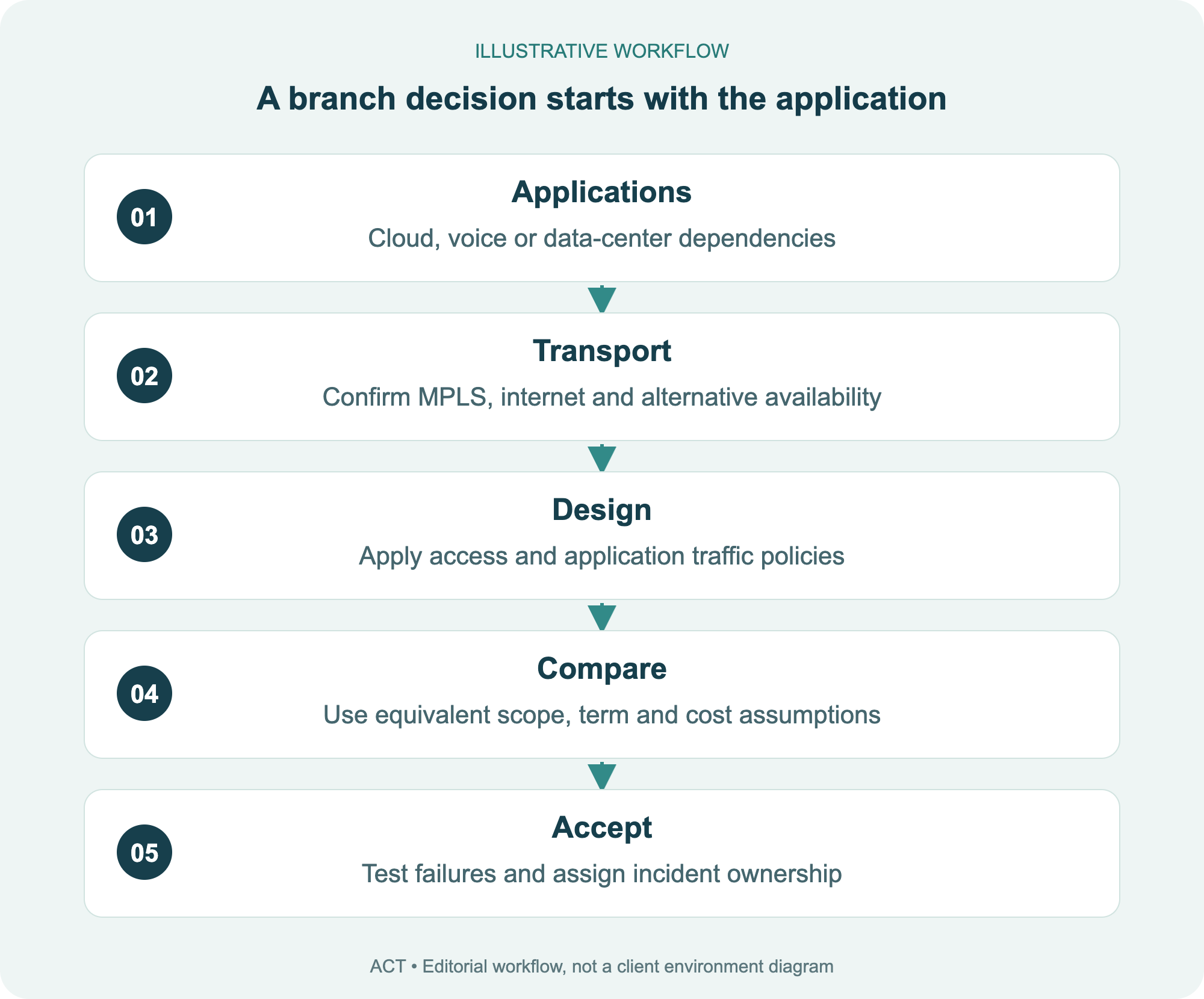
A branch decision starts with the application.
The diagram is a decision sequence, not a packet-flow diagram or a representation of a specific vendor architecture.
Build a transparent cost worksheet
Compare options using the same sites, capacity assumptions, service scope and period. Request dated quotations and record the currency, tax treatment, validity and exclusions. No fixed market price or savings percentage can be inferred from the technology name alone.
| Cost item | Usually evaluated as | What to record |
|---|---|---|
| WAN circuits | Recurring | Site, capacity, term, provider scope and quote date |
| Platform licences | Recurring or term-based | Included capabilities, device/site basis and renewal assumptions |
| Equipment | One-time or contracted rental | Supported capacity, accessories and replacement coverage |
| Deployment and migration | One-time | Site work, testing, travel and coordination scope |
| Operations and security support | Recurring | Coverage, responsibilities and exclusions |
| Parallel running | Temporary | Overlap period for existing and new services |
| Contract transition | Conditional | Confirmed obligations and charges under the actual agreements |
For a comparison period of N months, use: one-time implementation costs + recurring costs over N months + identified transition costs. Adjust the calculation for different billing periods and price changes; do not count a term licence again as a monthly charge. Keep non-price factors, such as service availability and operating risk, visible beside the total.
ACT’s enterprise networking and SD-WAN solutions are relevant when defining the technical scope to quote. A useful request includes the branch scenarios and acceptance tests, not only a requested circuit speed.
Test before extending the design
- Choose pilot branches that represent the different application and connectivity conditions.
- Capture the normal application experience and current routing assumptions.
- Test loss and restoration of each relevant path under an approved change plan.
- Verify voice, authentication and critical transactions during the transition.
- Review logs, policy decisions and any sessions that did not continue as expected.
- Obtain business acceptance and update the rollout plan before adding more branches.
| Failure case | Evidence required | Coordinating owner |
|---|---|---|
| Primary transport unavailable | Application results and the actual alternate path used | Network operations lead |
| Two links affected together | Provider investigation of shared dependencies | Named incident coordinator across carriers |
| Connectivity works but an application fails | Session, policy and application evidence correlated by time | Network lead with the application owner |
| Restored link behaves unexpectedly | Policy and application checks after restoration | Operations team with platform support |
Define responsibility for diagnosis across the carrier, SD-WAN platform and internal network. Review IT operations and support services when deciding who coordinates incidents and maintains the accepted design.
Common comparison errors and rollout checklist
Avoid assuming that internet links always cost less overall, that two provider names prove physical diversity, or that the same design fits every branch. A successful link failover also does not prove that every application session survived.
Before approving rollout, confirm:
- Each branch has an application profile and a feasible connectivity design.
- Available services and physical dependencies have been checked.
- Encryption, access and traffic policies have named owners.
- Quotes use comparable terms and disclose exclusions.
- Failure and restoration tests include business acceptance.
- Carrier and platform escalation responsibilities are agreed.
- Exceptions and remaining risks are visible in the operating record.
The strongest comparison produces a conditional decision for each branch type, with evidence that operations can maintain it.
Frequently Asked Questions
How should long-term MPLS contracts affect the rollout sequence?
Include remaining terms, renewal dates and confirmed transition obligations in the rollout plan. A phased approach may avoid unnecessary overlap, but the right sequence also depends on application risk and site readiness. Do not infer termination charges without checking the actual agreement.
Does a private MPLS connection automatically encrypt application traffic?
No. Isolation within a provider VPN and encryption of application traffic are separate properties. Determine where confidentiality and integrity protection are required, and verify the selected controls. A private circuit label is not evidence that traffic is encrypted end to end.
How can a team check whether two WAN links share a physical failure point?
Ask the providers to confirm relevant routing and entry dependencies, then document the evidence available to the project. Check building access, local infrastructure and power as well as the commercial provider name. Where independence cannot be confirmed, keep the shared-risk assumption visible.
How should voice traffic affect the branch connectivity decision?
Measure delay, variation, loss and actual call behaviour under normal and failed-path conditions. Agree acceptable outcomes with the users and service owner. Additional bandwidth alone may not solve a path-quality problem, so test the application rather than relying only on circuit specifications.
Can a company migrate only selected branches first?
Yes. Choose branches that represent the major application, transport and support conditions, then use their results to refine the next wave. A pilot composed only of the easiest sites can conceal problems that will appear when the design reaches more constrained locations.
Which applications should be tested during a simulated link failure?
Include the services whose interruption materially affects the branch, such as identity, voice, transactions and required data-center access. Test representative sessions and new connections. The list should come from business impact, not simply from the applications easiest to demonstrate.
How does direct cloud access affect the WAN design?
It changes the traffic path and the location where security and operating controls must be applied. Review cloud access, inspection, authentication and troubleshooting together. A shorter route is not automatically acceptable if it bypasses a required control or creates an unsupported operating path.
How should one-time deployment costs be compared with recurring WAN charges?
Use a common comparison period and separate implementation, recurring and transition items. Apply the billing frequency correctly, disclose exclusions and avoid counting a licence twice. Keep the original quotation date and assumptions so the comparison can be updated when the scope changes.
Can existing routers be retained during an SD-WAN rollout?
Only if the specific hardware, software, capacity and support status meet the intended design. Verify compatibility and test the configuration before relying on reuse. An existing router’s ability to forward traffic does not establish that it supports the required SD-WAN functions.
What if the preferred branch design is unavailable at one location?
Create a documented site exception with a feasible design, its limitations and the required acceptance tests. Assess how the exception changes monitoring, support and business continuity. Avoid promising the same service outcome where the available transport conditions cannot support it.
Who manages incidents involving both the carrier and the SD-WAN platform?
Name an incident coordinator who owns the end-to-end investigation, with clear responsibilities for the carrier, platform provider and internal team. Agree evidence exchange and escalation routes. Multiple suppliers should not leave the business responsible for deciding which party starts diagnosis.
What changes when the business later adopts SASE?
Review how security service locations, access policies and traffic paths interact with the WAN. Some existing components may remain useful, while others need reconfiguration or replacement. Validate compatibility and application behaviour rather than assuming that an SD-WAN deployment automatically completes a SASE design.
Next steps
Create a branch inventory that groups sites by application needs and feasible transport. Use it to request comparable proposals and select representative pilots before committing to a network-wide rollout.