

Key takeaways
- Confirm the source system, exact version and agreed migration scope first.
- Reconcile both record completeness and the financial meaning of the data.
- Test hotel workflows, night audit and interfaces under the selected configuration.
- Use department evidence and unresolved exceptions to make the go-live decision.
Confirm the source system and readiness owners
Document the source PMS, version and build, target environment, property scope, migration route and supplier responsibilities. Do not assume that every source version, custom report or interface can follow the same route. Confirm technical eligibility before agreeing the final migration window.
Oracle’s hospitality consulting service descriptions distinguish migration activities, validation and customer responsibilities within defined service scopes. Use the actual proposal to establish what is included in your project; a data migration service should not automatically be treated as including every training, interface or go-live support activity.
| Department | Acceptance responsibility | Useful evidence |
|---|---|---|
| Front office | Arrival, room move, billing and departure workflows | Completed user acceptance scenarios |
| Reservations | Booking details, amendments, inventory and rate-plan accuracy | Reconciliation records and exception decisions |
| Housekeeping | Room status and coordination with front office | Cross-department workflow results |
| Finance | Deposits, agreed balances and financial controls | Signed reconciliation and night-audit evidence |
| IT | Access, connectivity, interfaces and support readiness | Configuration, test and escalation records |
Include the hospitality IT infrastructure supporting these workflows. A valid reservation is not enough if the team cannot reach the system or its required interfaces.
Reconcile data before approving migration
Define the data population before comparing totals: which properties, dates, reservation statuses, profiles and balances are included? A source and target total are meaningful only when they represent the same scope and cut-off time.
Check key fields as well as counts. A reservation may exist but have the wrong room type, rate plan or deposit relationship. Record intentional transformations, such as an approved profile-merge rule, so an expected difference is not confused with an error.
- Agree the extraction scope and a consistent cut-off point.
- Clean duplicates and invalid references under approved business rules.
- Test the mapping and retain traceable source-to-target references.
- Compare counts, selected records and agreed financial totals.
- Investigate differences and record the business owner’s decision.
- Control amendments during the migration window and reconcile them again.
Use a department sign-off and reconciliation register
The following is an illustrative hotel acceptance exercise with simulated results, not an ACT customer case. It assumes an OPERA 5 source for explaining readiness only. Exact build compatibility, the supported migration route and licensed scope are not established by this example and require separate confirmation.
| ID / department and owner | Dataset or workflow | Acceptance criterion | Simulated before / after observation |
|---|---|---|---|
| H01 / reservations manager | 120 in-scope bookings, including amended dates and rate plans | All required bookings and critical fields reconcile | Source 120; target 119; one amended booking absent |
| H02 / front office manager | Arrival, room move and departure | Each approved journey completes with correct reservation and folio | Three source journeys defined; three target journeys pass |
| H03 / housekeeping supervisor | Four room-status changes | Front office receives the intended status updates | Four expected changes; four matched updates |
| H04 / finance controller | Agreed deposit population in EGP and night-audit scenario | Deposit totals reconcile; configured end-of-day checks pass | EGP 50,000 source; EGP 49,500 target; deposit difference unresolved |
| H05 / hotel IT manager | Four required interfaces | All interfaces have accepted test evidence and a support owner | Three accepted; one POS interface awaiting retest |
| ID | Evidence and unresolved difference | Go/no-go position | Corrective owner |
|---|---|---|---|
| H01 | Booking reference and amendment history identify the missing record | Hold reservation sign-off | Migration team with reservations manager |
| H02 | User acceptance test (UAT) records for all three journeys | Department pass; does not override other holds | Front office manager |
| H03 | Room-status test record and cross-department confirmation | Department pass | Housekeeping supervisor |
| H04 | Deposit comparison shows EGP 500 difference; night-audit acceptance remains open | Hold financial sign-off | Finance controller with data migration lead |
| H05 | Interface log and failed transaction reference attached to retest request | Hold integration sign-off | Interface owner and hotel IT manager |
The overall decision in this example is no-go until the recorded blockers are resolved or handled through an authorised exception consistent with the agreed acceptance rules. Department passes do not cancel unresolved financial or integration gaps. The example’s amounts and observations are teaching data only.
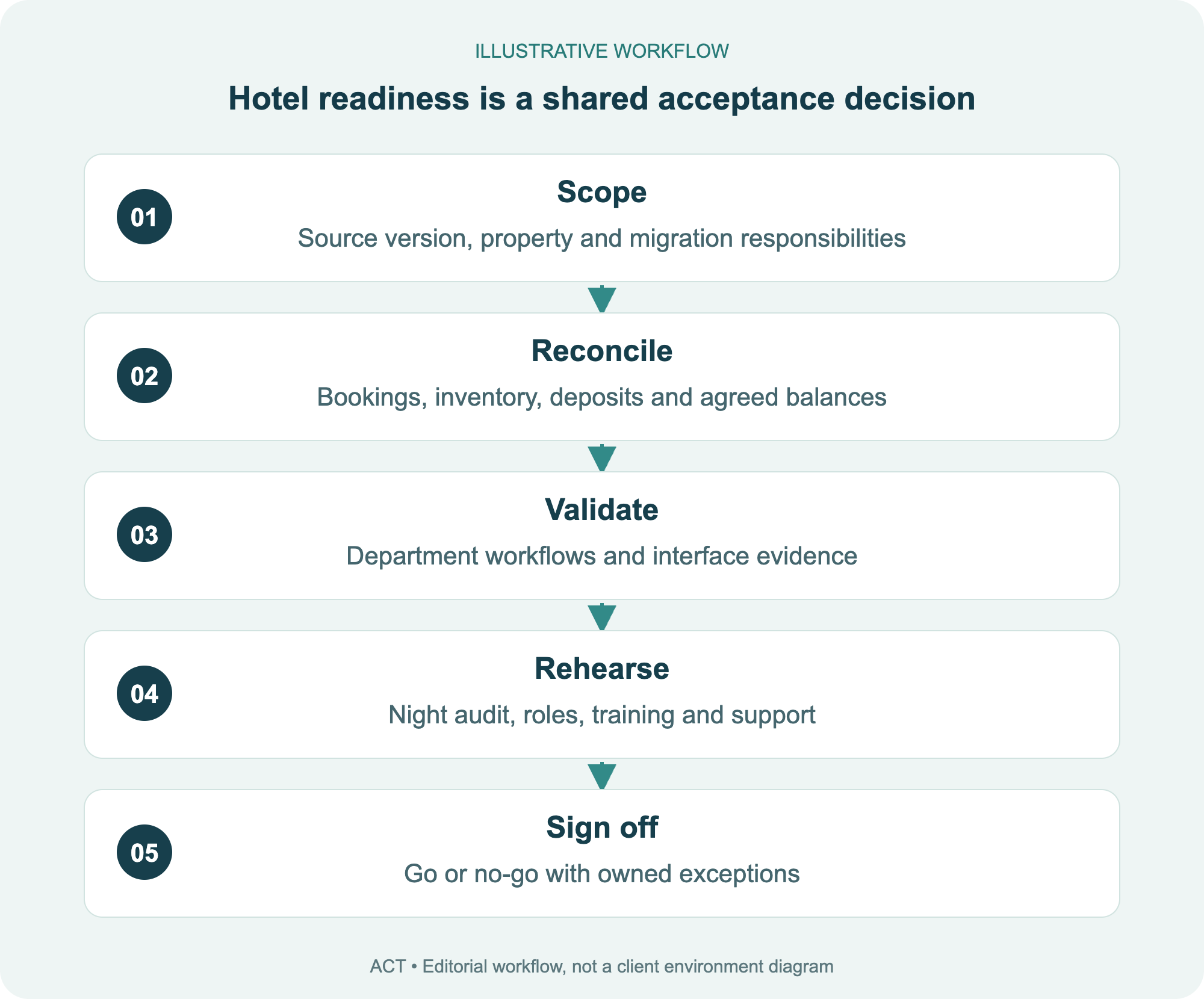
Hotel readiness is a shared acceptance decision.
Track interfaces without losing the hotel-wide view
Create an interface register covering the systems used by the property: POS, channel management, distribution, access systems, finance exports and other relevant connections. Identify versions, configuration ownership, test status and the party responsible for defects.
At the migration level, the register answers whether each interface is ready and who accepts it. Transaction-level evidence belongs in the individual interface test plan. This distinction prevents an overall migration checklist from becoming an incomplete substitute for detailed integration testing.
If the hotel uses mobile check-in workflows, include the actual reservation, identity and operating handoffs involved. Do not assume that a previously working guest journey remains unchanged after the PMS transition.
Rehearse hotel operations and night audit
Run representative arrival, room-change, departure and financial-review scenarios in the approved test environment. Include exceptions that staff actually handle, and validate cross-department permissions rather than giving every tester administrative access.
Oracle’s End of Day documentation describes processing affected by OPERA Controls, including departure and cashier-related conditions. Review the documentation for the selected release and configuration; do not treat one property’s night-audit behaviour as universal.
Training readiness needs task evidence, not attendance alone. Ask designated users to complete the required workflows, identify an exception and follow the support route. Record where assistance is still needed and who will be available during cutover and early operation.
Run a documented go/no-go review
| Readiness state | Decision to consider | Required follow-through |
|---|---|---|
| Required data, workflows and interfaces accepted | Proceed within the approved window | Confirm communication, support and monitoring |
| Minor exception within an approved tolerance | Proceed only with the named owner’s recorded acceptance | State the control, correction owner and deadline |
| Unresolved critical data, finance or operating issue | Hold the affected sign-off and reassess go-live | Correct, retest and reconvene the decision |
Document how connectivity loss, unresolved transactions and operational fallback will be handled. A generic promise of “rollback” is insufficient after guests, payments or reservations have changed in the target. The feasible response depends on the platform, migration method and recorded data state.
ACT provides hotel PMS and OPERA solutions. A useful project discussion starts with the property scope, current systems, interfaces and department acceptance requirements.
Common readiness gaps and final checklist
Watch for totals compared across different cut-off times, migrated records with incorrect business fields, and training signed off solely from attendance. Another common gap is retiring the previous PMS before retention, historical access and the transition strategy are settled.
- Source version, route and scope are confirmed with the responsible parties.
- Booking, inventory, rate and financial checks use matching populations.
- Amendments during cutover have an owner and a reconciliation method.
- Every department has evidence and a sign-off decision.
- Interfaces and night audit have passed the applicable tests.
- Staff can perform their roles and follow the support procedure.
- Open defects, exceptions and fallback conditions are explicit.
- Access to the previous PMS has an approved retention and retirement decision.
The final approval should describe the hotel’s ability to operate, rather than simply record that the migration process finished.
Frequently Asked Questions
Which OPERA source-version details must be confirmed before migration planning?
Confirm the product, exact release and build, hosting setup, property scope and relevant customisations. Ask the responsible supplier to establish the supported migration route and prerequisites. A generic label such as OPERA 5 does not establish compatibility for a specific installation.
How should duplicate guest profiles be handled before migration?
Agree a business-approved matching and merge policy before applying changes. Preserve the references needed to trace affected reservations and records, then validate the result. Do not merge profiles solely because names look similar or because a smaller record count appears cleaner.
What should happen to reservations changed during the migration window?
Assign ownership for changes made after the agreed cut-off and define how they reach the target. Reconcile affected booking fields and related balances before acceptance. A successful initial extract does not cover amendments made later in the transition window.
Can OPERA Cloud go-live be approved while deposit totals still differ?
An unexplained difference should hold financial sign-off. Any exception requires an explicit decision consistent with agreed acceptance rules, including its impact and corrective ownership. Do not assume that a small-looking amount is immaterial or that technical completion overrides the finance decision.
Should all properties in a hotel group go live at the same time?
Not necessarily. Compare property dependencies, shared services, staffing and support capacity before choosing a phased or simultaneous rollout. A successful group migration elsewhere does not prove that the same approach suits your operating model or that all properties are equally ready.
How can night-audit workflows be tested before hotel go-live?
Use representative reservations, cashier states and financial checks in the approved test environment. Validate the applicable OPERA Controls and review the resulting reports with finance and front office. Include expected exceptions so the rehearsal tests more than an uncomplicated end-of-day run.
How should cross-department user access be validated during hotel acceptance testing?
Ask users in each role to complete their authorised steps and verify that handoffs work without unnecessary access. Include restricted actions and cross-department dependencies. Testing with administrator accounts alone can hide both permission problems and excessive privileges.
How should a hotel plan for a connectivity failure during cutover?
Agree a supported continuity procedure, communication route and reconciliation method before the window. Confirm what the selected platform and interfaces can actually do without connectivity. Do not promise offline operation or automatic recovery behaviour unless it is supported and tested for the configuration.
Can existing channel-management integrations be reused?
Only after checking the target compatibility, interface version, configuration and supplier scope. Reuse may still require changes and a new acceptance test. Keep ownership of bookings, updates and error handling clear across the PMS and channel-management provider.
How can hotel managers verify training readiness beyond attendance records?
Use practical role-based tasks with observable outcomes, including an exception and a support request. Record who can complete the work without unplanned assistance and where reinforcement is needed. Attendance confirms participation, not the ability to operate the new workflow.
Who approves unresolved rate-plan or room-inventory exceptions before go-live?
The relevant business owner, such as reservations or revenue management, should decide within the hotel’s agreed acceptance process. Record the affected population, operational effect, correction owner and deadline. IT should provide evidence without independently accepting a commercial inventory or pricing error.
When can access to the previous PMS be removed?
Remove it after historical access, retention, unresolved reconciliation and the approved transition strategy have been addressed. Assign ownership of archived records and any remaining read-only access. Do not equate target go-live with immediate permission to remove every source-system dependency.
Next steps
Bring the department owners together around one scope and reconciliation register. Resolve the differences that prevent operating acceptance before committing the hotel to a final cutover decision.