

Key takeaways
- Compare task ownership rather than relying on the label of the service.
- Use a RACI matrix to identify execution, accountability, consultation and communication.
- Separate response commitments from resolution or restoration targets.
- Define onboarding, supplier coordination and exit handover before service begins.
Choose the model from capacity and ownership
An internal team may need specialist infrastructure coverage while retaining its help desk and application knowledge. Another organisation may want a provider to execute a broader operational scope. Neither choice automatically changes the business’s ownership of its systems, decisions or data.
For background on the support function, review IT support services and business continuity. The decision here is how to allocate the actual work and the authority needed to perform it.
| Decision area | More fully managed scope | Co-managed scope |
|---|---|---|
| Daily execution | Provider handles most agreed operational tasks | Provider and internal team split named tasks |
| Internal capability | Retains governance, service ownership and business decisions | Also retains selected hands-on operational skills |
| Main coordination risk | Assuming the provider covers an unlisted system or activity | Gaps or duplication at the boundary between teams |
| Useful starting question | What remains with the organisation? | Where does each task pass from one team to the other? |
Assess coverage hours, existing skills, recurring workload and dependence on individuals. A model that works during ordinary business hours may fail when the only internal administrator is unavailable. Record that gap explicitly rather than assuming a provider will absorb it.
Build the RACI before comparing proposals
RACI identifies who is Responsible for doing the work, Accountable for the outcome, Consulted for input and Informed of progress or results. Microsoft’s responsibility-alignment guidance uses these roles to make cross-team responsibilities explicit.
The following is an illustrative co-managed allocation, not ACT contract terms. Each row has one accountable role. The labels refer to roles that the organisation must assign to real people or teams.
| Operational task | R: executes | A: accountable | C: consulted | I: informed |
|---|---|---|---|---|
| User help desk | Internal service desk | Internal IT lead | Provider for infrastructure issues | Requesting user |
| Infrastructure monitoring | Provider operations | Internal IT lead | Application owner | Internal service desk |
| Approved server patching | Provider operations | Change authority | Security and application owners | Service desk |
| Backup operation and checks | Provider operations | Data owner | Security lead | Internal IT lead |
| Recovery exercise execution | Provider recovery team | Business service owner | Data and security owners | Operations stakeholders |
| User access provisioning | Internal identity team | Application owner | Security and provider where needed | Service desk |
| Major-incident coordination | Internal incident lead | Internal IT lead | Provider and affected vendors | Business service owner |
| Infrastructure vendor case management | Provider support | Internal IT lead | Vendor and application owner | Service desk |
Use the matrix to challenge each proposal. If the provider monitors backups but nobody validates restoration, the responsibility set is incomplete. Where an accountable role lacks decision authority or an executive role lacks access, the row cannot operate as written.
Read the SLA as an operating document
An acknowledgement, investigation, workaround, service restoration and permanent fix are different events. Define which event a commitment measures and when its clock starts, pauses and stops under the actual agreement. Do not equate a rapid response with a guaranteed repair time.
| SLA review item | What the proposal should make clear | Evidence for service reviews |
|---|---|---|
| Coverage | Days, hours, time zone and after-hours process | Incident timestamp against the agreed coverage |
| Severity | Business impact criteria and who may change priority | Initial classification and any approved change |
| Response | Meaningful response event and measurement rules | Ticket acknowledgement and engagement records |
| Restoration or resolution | Defined outcome, target and dependencies | Service validation or closure evidence |
| Exclusions | Uncovered systems, supplier delays and other agreed boundaries | Specific exclusion applied to the incident |
| Escalation | Technical and management routes with ownership | Escalation records and decisions |
| Reporting | Calculation method, reporting period and corrective follow-up | Traceable source records, not only averages |
The list is a proposal-review tool, not a statement that all providers use identical SLA rules. Agree the definitions before comparing figures. ACT lists both fully managed and co-managed options within its managed IT operations.
Walk through an incident and a planned change
Consider an illustrative incident, not a reported customer event: staff cannot use a business application, while the provider’s infrastructure monitoring shows an alert. The provider investigates the monitored platform, and the internal incident lead coordinates the wider response.
- The service desk records business impact and links duplicate reports.
- Provider operations checks the monitored infrastructure and records findings.
- The incident lead brings in the application vendor if evidence crosses that boundary.
- The authorised change owner approves any proposed intervention or workaround.
- The business service owner verifies that essential work has resumed.
- The incident lead records remaining work, supplier dependencies and communication.
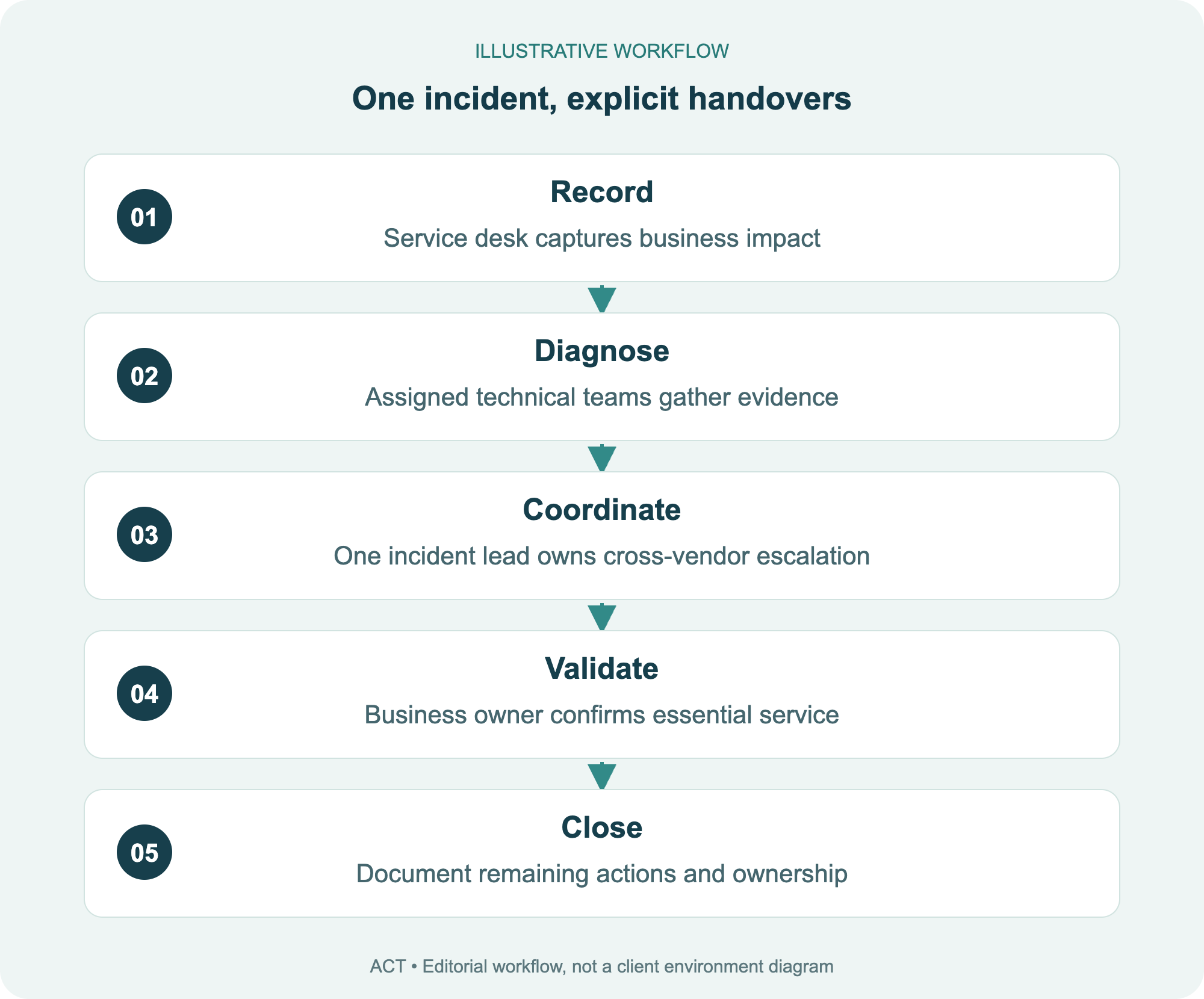
One incident, explicit handovers.
This sequence keeps diagnosis with the appropriate technical team while retaining one coordination owner. It also prevents a provider’s “infrastructure healthy” update from being mistaken for business-service recovery.
A planned patch follows a different path: provider operations prepares the change, the designated authority approves its timing and risk, the provider executes, and the application owner validates the agreed functions. The recurring patching scope should say whether compatibility testing, maintenance windows and rollback work are included.
Document scope and service transitions
Separate recurring operations from projects, new-site deployments, application development and exceptional onsite work. An activity being technically related to support does not establish that it is included commercially. Describe how a new request is assessed and authorised before execution.
| Transition stage | Records to exchange | Acceptance question |
|---|---|---|
| Onboarding | Asset and service inventory, access ownership, known issues and support contacts | Can the assigned team operate the agreed scope? |
| Steady operation | Changes, incidents, service reports and updated recovery instructions | Do records reflect the environment currently being supported? |
| Exit or provider change | Current configurations, documentation, open cases, data ownership and access-removal plan | Can the receiving team take control without relying on undocumented knowledge? |
Handle credentials and privileged access through approved secure processes. An exit checklist should identify which access is transferred, revoked or retained temporarily, with an owner and expiry. It should not distribute passwords in an ordinary handover document.
Common scope gaps and selection checklist
Common gaps include both teams assuming the other owns patching, no owner for multi-vendor incidents, and reports that combine provider performance with unexplained supplier delays. Another is treating staff augmentation as if it necessarily includes the same service management responsibilities as a managed service.
Before choosing a model, confirm:
- Every recurring task has a named executor and accountable owner.
- Coverage matches the operating needs of the business.
- Required access and decision authority accompany the assigned work.
- Response, restoration and resolution are defined separately.
- Project work and exclusions have an approval route.
- Incident reporting distinguishes provider activity from external dependencies.
- Onboarding and exit records have acceptance owners.
- The model will be reviewed when internal capability or service scope changes.
The strongest proposal is the one whose responsibilities can be followed through an actual incident and a planned change, not the one with the broadest service label.
Frequently Asked Questions
Can a company keep its help desk while outsourcing infrastructure operations?
Yes. That is a common way to divide a co-managed scope, provided the help desk knows when and how to escalate infrastructure issues. Define ticket ownership, evidence transfer and business communication so users do not have to navigate the boundary between the two teams.
Who retains administrative access in a co-managed arrangement?
Define access by operational need, security policy and ownership of the systems. The organisation should retain appropriate control and visibility, while the provider receives the access required for its assigned work. Specify approval, logging, review and removal of privileged access.
What happens when both the internal team and provider assume the other owns a task?
Use the agreed accountable owner to resolve the immediate gap, then correct the RACI and service scope. Record the decision in the operating documentation. An informal workaround may restore service, but it should not leave the same ambiguity in place for the next incident.
How should after-hours coverage be described in a proposal?
State the covered days, hours, time zone, entry channel and escalation conditions. Clarify whether the arrangement is active monitoring, on-call support or another model. A phrase such as “after-hours support” is incomplete without explaining when and how the service is activated.
Can an incident severity change after the SLA response clock has started?
It can if the agreement defines reclassification and measurement rules. Record the original impact, the new evidence and the authorised decision. Do not assume that a severity change automatically resets the clock or removes time already spent handling the incident.
Who owns patching when several technology vendors are involved?
Assign one accountable owner for the activity and define each vendor’s execution or consultation role. Include compatibility assessment, approval, installation and validation. Having several technology suppliers does not remove the need for an owner who confirms the complete patching outcome.
How are planned projects separated from recurring support?
Define which changes are included in recurring operations and which require a separate scope and approval. Use examples such as new-site deployment, platform replacement or application development. Record how a request is classified before assuming either that it is included or that it is chargeable.
Can a co-managed contract include temporary staff augmentation?
It may, if the agreed service includes it. Clarify whether the additional person works under internal direction or delivers an outcome managed by the provider. Staff availability, supervision and service accountability should not be inferred solely from the co-managed label.
How should a service review report separate provider performance from supplier delays?
Show the timeline, party responsible for each action and evidence for any applied exclusion or waiting period. Report the business restoration outcome alongside provider activity. An unexplained average can hide whether recurring delays arise from the provider, another supplier or an internal decision.
Who coordinates security incidents across IT and security providers?
Name a coordination owner and define the roles of IT operations, security response and affected vendors. Agree how incidents are classified and communicated. Coordination should preserve security evidence and business decision authority without assuming that every operational provider performs the same security function.
Which documents should be returned when an IT service contract ends?
Return or transfer the agreed current inventories, configurations, operating procedures, recovery records, open cases and relevant service reports. Confirm data ownership and the access-removal process. Sensitive credentials require a secure transfer method, rather than being included in an ordinary exit spreadsheet.
What signs suggest that the agreed operating model needs to change?
Review the model when internal skills, coverage requirements, application scope, incident patterns or business priorities change. Repeated handover gaps are another signal. Use evidence from service reviews to adjust responsibilities before the mismatch becomes a recurring source of outages or unapproved work.
Next steps
List the operational tasks your team must cover and assign an accountable owner to each. Use that record to compare proposals, validate SLA definitions and agree the handover points that the selected model must support.
Discuss the right IT operating model for your team with ACT.