

Key takeaways
- Set RTO and RPO for business services, with their dependencies included.
- Distinguish a recovery target from a measured exercise result.
- Test business functionality as well as infrastructure availability.
- Keep corrective actions open until evidence supports a retest decision.
Map business impact to recovery priorities
Ask service owners what work stops when an application becomes unavailable, how long a workaround can operate and which data the process needs. Rank services by these consequences rather than by the visibility or purchase price of their servers.
A recovery sequence should include shared identity, DNS, network access, storage and supplier dependencies. Restoring the main application before a required identity service may leave users unable to work. Microsoft’s disaster recovery guidance places business priorities, measurable objectives and documented recovery decisions at the centre of planning.
Create an ownership record for every critical service: business owner, technical lead, activation authority, deputy and communication contact. Make the record usable when normal collaboration tools are unavailable.
Set RTO and RPO without confusing them
Recovery time objective (RTO) is the maximum acceptable service interruption for the agreed scope. Recovery point objective (RPO) is the acceptable data-loss window, expressed in time. AWS’s recovery objectives guidance relates these objectives to application impact and risk assessment.
| Question | Objective | How the exercise checks it |
|---|---|---|
| How quickly must essential work resume? | RTO | Measure from the agreed interruption point until the approved functions are usable |
| How far back may the recovered data be? | RPO | Compare the disruption point with the latest verified usable data point |
Agree the measurement rules before testing. If the RTO concerns order entry and order retrieval, a login screen alone is not recovery. Likewise, a backup completion timestamp does not establish which business records can be recovered.
Choose controls and write the recovery runbook
Backup, replication, failover and failback serve different roles. Backup preserves recoverable copies; replication maintains another copy or state; failover moves service to an alternative; failback returns operation to the intended primary environment. The design must address data integrity as well as availability.
AWS’s recovery strategy guidance compares approaches with different readiness and recovery characteristics. Select a design against your own workload objectives and test it; a product category does not guarantee a recovery time.
| Control or action | Planning question | Evidence to request |
|---|---|---|
| Backup and restore | Can the required data and configuration be restored together? | A validated restore and usable application records |
| Replication | Can corruption or unwanted changes reach the other copy? | Defined protection boundaries and a tested clean recovery point |
| Failover | Are identity, access and application dependencies ready? | Completed business tests in the alternative environment |
| Failback | How will new data and traffic return safely? | A reconciled data state and approved return sequence |
The runbook should identify activation conditions, authority, the service restoration sequence, verification tasks and communication checkpoints. ACT’s data protection and disaster recovery solutions are relevant when assessing the technology scope; the project still needs explicit acceptance criteria.
Run an exercise that produces usable evidence
- Define the scenario and whether production traffic is involved.
- Confirm approval, the safety boundary and the conditions for stopping the exercise.
- Record the interruption point and required recovery functions.
- Execute the authorised runbook while preserving timestamps and action records.
- Validate application transactions and the recovered data point.
- Compare the observations with the approved targets and assign corrective work.
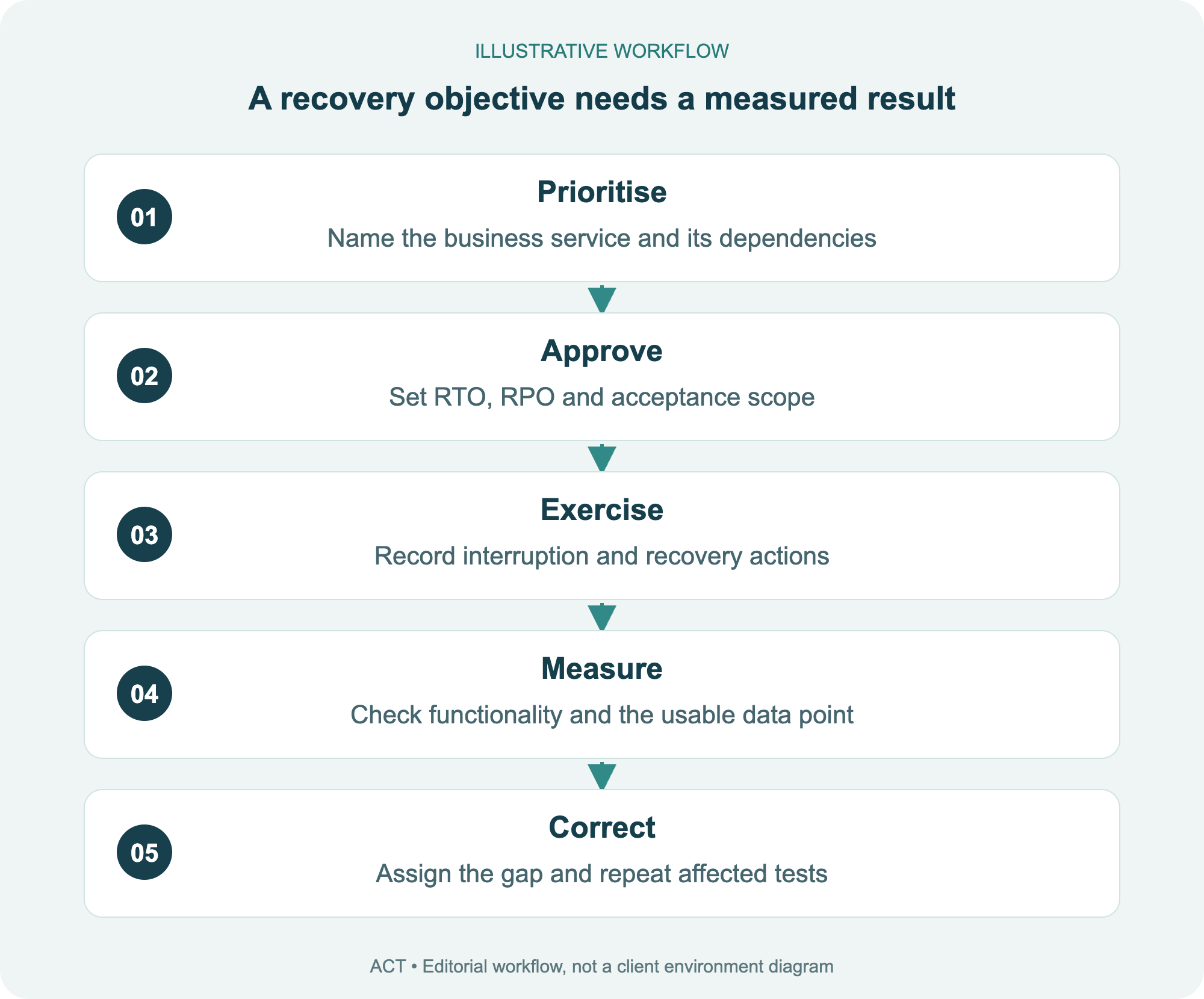
A recovery objective needs a measured result.
A tabletop exercise can reveal missing decisions and contacts. An isolated restore can demonstrate restoration of selected components. Neither automatically proves full production failover. State precisely what the exercise did and did not test.
Recovery test template: target versus measured result
The following is an illustrative exercise with invented teaching data, not an ACT result or contractual SLA. The service is an order-management application; acceptance requires users to create and retrieve orders with the required permissions.
| Record | Illustrative value |
|---|---|
| Service and owner | Order management; commercial operations owner |
| Approved RTO / RPO | 120 minutes / 20 minutes |
| Measurement start | Simulated service interruption at 10:00 |
| Accepted functionality restored | 11:25, after order creation and retrieval checks |
| Latest verified usable data point | 09:35 |
| Recovery scope | Application, database, identity dependency and test user access |
| Evidence set | Exercise action log, transaction references and business acceptance record |
| Measure | Calculation | Result and action |
|---|---|---|
| Actual recovery time | 11:25 minus 10:00 = 85 minutes | Within the 120-minute RTO; 35 minutes inside the target |
| Actual data-loss window | 10:00 minus 09:35 = 25 minutes | Exceeds the 20-minute RPO by 5 minutes |
| Corrective ownership | Data platform lead investigates the recovery-point gap | Service owner keeps overall acceptance open |
| Retest appointment | Day 3 of this illustrative exercise plan, 09:00, after the correction is verified | Repeat data-point validation and the affected business tests |
Meeting one objective does not compensate for missing the other. The five-minute RPO gap is an observed shortfall in the example, not a reason to rewrite the target after the exercise. The business owner must decide the appropriate response with the technical team, and the retest must show whether the change addressed the cause.
Use published project evidence within its limits
ACT’s Telecom Egypt data management project describes a unified Commvault-based approach to protecting different workload types. The published case does not provide measured RTO or RPO results. It supports the data-protection context, while the exercise figures above remain a separate teaching example.
When discussing data protection and continuity services, specify the services to recover, evidence required and responsibilities for correcting gaps. A general backup scope should not be treated as an approved recovery commitment.
Common testing mistakes and evidence checklist
Typical mistakes include starting the timer only after difficult prerequisites are complete, checking server startup without business transactions, and calling a restore successful before validating the data. Another is collecting screenshots without linking them to a service, test step or timestamp.
Keep the following evidence for each exercise:
- The approved scenario, targets and scope exclusions.
- The actual start point and timeline of restoration actions.
- The latest verified usable data point and how it was established.
- Business test results, defects and acceptance decisions.
- Corrective owners, deadlines and retest conditions.
- A decision about failback, temporary operation and remaining risk.
Review the plan after changes to applications, dependencies, recovery tooling or business priorities. A successful historical test is evidence of the configuration and conditions that were tested, not permanent proof of recoverability.
Frequently Asked Questions
Can two applications sharing a database have different recovery targets?
They can have different business tolerances, but the shared database may constrain how independently they recover. Record both requirements and test the combined dependency. Where the design cannot meet each target, obtain an explicit architecture or business-priority decision.
Can backup jobs succeed while a recovery attempt still fails?
Yes. A backup job can complete while recovery later fails because of missing keys, incompatible configuration, damaged data or unavailable dependencies. Demonstrate recovery by restoring and validating the required service, rather than relying only on job status.
Who should declare a disaster and activate the recovery runbook?
The organisation should name an activation authority and a deputy in advance. Define the circumstances that justify activation and how the decision is communicated. Technical staff need clear authority to proceed without guessing who may accept business impact.
How should recovery account for external identity and DNS services?
Include the availability, access methods, contacts and recovery limitations of those dependencies. Test the path users and applications will actually use. If recovery requires an external service that is unavailable, record the limitation rather than reporting the application as independently recoverable.
How should ransomware scenarios affect recovery validation?
Recovery validation should include security approval of the selected recovery point and the environment used to restore it. Coordinate with the incident response team before reconnecting restored systems. Replicating data to another location does not by itself establish that the data is clean.
How should recovery tests be scoped when a full production failover is not approved?
Use an approved tabletop, isolated restore or limited component exercise, and state the boundary of its evidence. Identify the production behaviours that remain untested. A successful limited test should not be presented as proof of full end-to-end production recovery.
Does a partial recovery count as meeting the approved RTO?
Only if that partial service is the minimum usable scope approved before the test. Record which functions are available and which remain unavailable. Do not redefine acceptance after the event simply to turn a missed target into a passed result.
How is actual data loss checked against the agreed RPO?
Identify the latest consistent and usable recovered business data, then compare its timestamp with the disruption point using the agreed method. Validate transactions and dependencies, not only file dates. Record any uncertainty or excluded records in the result.
When should a recovery plan be updated after a system change?
Review it when a change affects dependencies, data flows, access, capacity, recovery tooling or the business service itself. Update the relevant runbook and tests before treating the changed environment as covered. A small technical change can invalidate an important recovery assumption.
What approvals are needed before failback to the primary environment?
Confirm the primary environment is fit for service, the data state is reconciled and the return sequence is approved. Obtain business and technical acceptance for the planned impact. Failback should be a controlled change, not an automatic reversal after infrastructure comes online.
Who verifies the evidence when the recovery team also performs the test?
Assign a reviewer who can challenge the results and a business owner who accepts the recovered functions. Preserve source logs and transaction references so evidence can be checked independently of the operator’s summary. The exact assurance structure depends on the organisation.
Who decides whether temporary manual business processes are acceptable?
The business process owner should approve the workaround, its duration and its control requirements. Record how work created manually will later be reconciled. IT can describe technical constraints, but should not independently accept the operational consequences of a manual process.
Next steps
Choose one critical business service and approve its recovery definition before buying additional recovery capacity. Use a bounded exercise to expose the gap between the target and the evidence, then assign and retest the corrective work.
Discuss your data protection and recovery requirements with ACT.