

Key takeaways
- Group workloads around shared dependencies and business transactions.
- Agree acceptance evidence and rollback authority before scheduling cutover.
- Treat data written after cutover as part of the rollback problem.
- Retire the previous environment only after business and operational acceptance.
Define the outcome before selecting the wave
Start with a specific outcome: move a customer-facing application, reduce pressure on an existing platform, or introduce a supported hosting environment. Record the business owner, permitted service interruption, data restrictions, licence constraints and support requirements. These conditions may point to different destinations for different workloads.
If the hosting model is still undecided, first review hybrid cloud vs public cloud. This checklist assumes that an organisation will retain some systems on-premises while moving others. It does not assume every application benefits from moving immediately.
| Decision | Suitable situation | Evidence needed before proceeding |
|---|---|---|
| Move | Dependencies, support and business acceptance can be demonstrated | Tested connectivity and an agreed target configuration |
| Retain temporarily | A required component or operating constraint prevents a safe move | Named owner, documented reason and a review trigger |
| Reassess | The application design or business requirement is unclear | Additional discovery or a revised application decision |
Build a dependency-led workload register
A workload includes more than its visible application server. Look for shared databases, identity services, certificates, file transfers, scheduled jobs, reporting tools and external supplier connections. Interview the teams that operate them; a connection inventory alone may miss month-end processing or infrequently used interfaces.
For each dependency, record its direction, owner, authentication method and business purpose. Then test whether the proposed separation across environments changes latency, access or data consistency. Review IT infrastructure services when the project also needs changes to identity, operating systems or virtual infrastructure.
The following register is an illustrative planning example, not an ACT project result. An ERP application and an order integration worker share a database. Their owners decide to move the application group together after testing the database move.
| ID / workload | Business owner | Dependency | Current → target | Decision and wave |
|---|---|---|---|---|
| M01 / ERP application | Finance operations lead | M03 database; identity service | On-premises → cloud | Move in W2 with the application group |
| M02 / order integration worker | Sales operations lead | M03 database; supplier endpoint | On-premises → cloud | Move in W2; avoid an untested cross-environment write path |
| M03 / shared database | Data platform owner | Backup, storage and application writers | On-premises → cloud | Move in W2 after rehearsal; control both writers |
The register should also retain the licence decision, capacity baseline, migration method and target configuration. Put detailed configuration in controlled project records rather than a public article or an unsecured spreadsheet.
Turn dependencies into executable waves
Migration waves are groups of workloads moved under one coordinated plan. Microsoft’s migration wave guidance connects wave composition with dependencies and iterative learning. A successful low-risk pilot provides evidence about that pilot; it does not approve every later workload.
- Identify a representative pilot and its business acceptance owner.
- Confirm identity, connectivity, monitoring and recovery prerequisites.
- Group applications whose dependencies cannot be safely separated.
- Rehearse the immediate wave, including business transactions and scheduled processing.
- Update the following wave using issues discovered during rehearsal.
- Reserve enough time within the approved window for validation and a controlled fallback.
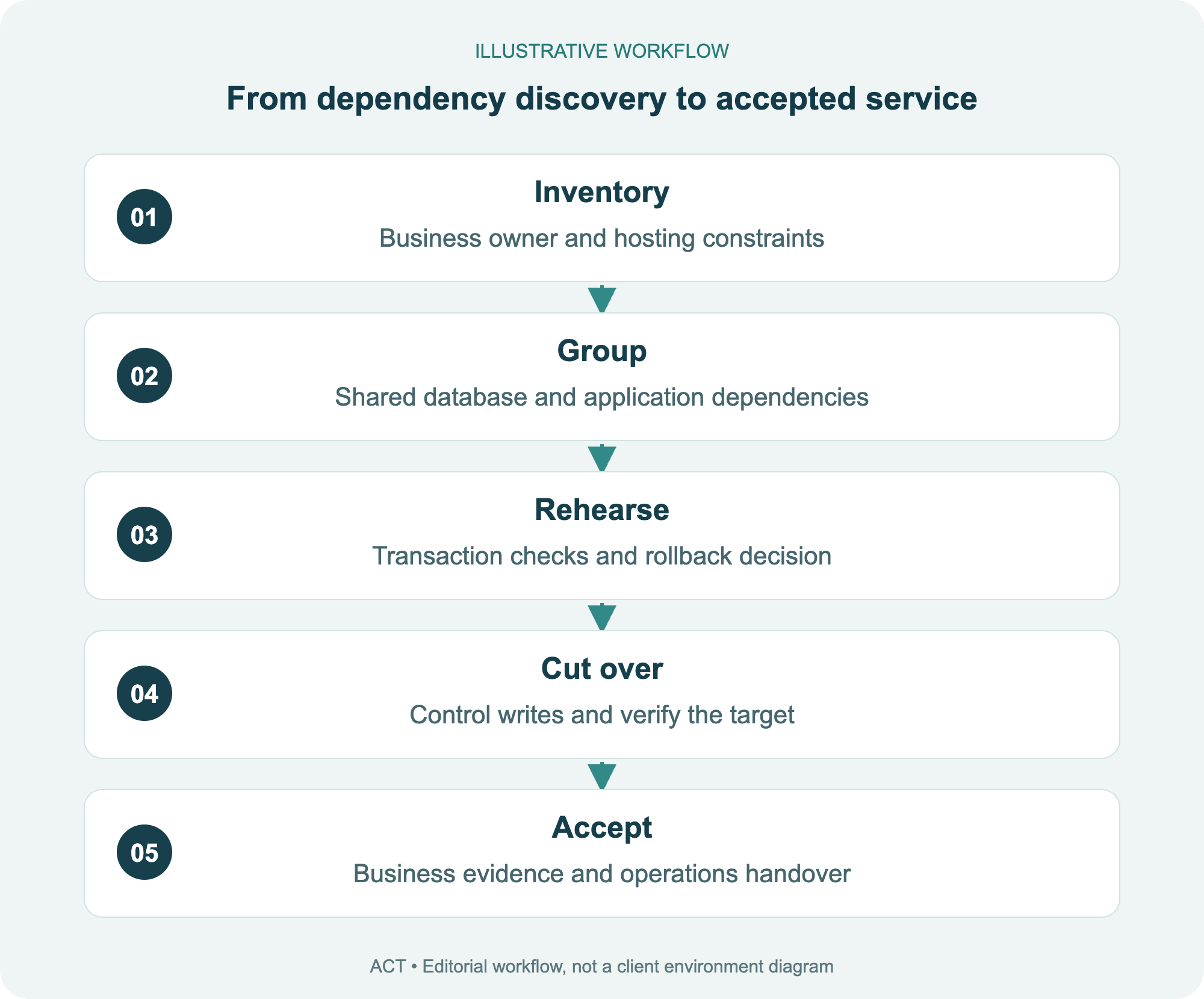
From dependency discovery to accepted service.
The sequence ends at a business acceptance gate. If an application starts but cannot complete its essential transaction, the migration has not reached that gate.
Rehearse cutover and define rollback triggers
Cutover transfers active use to the target environment. Its runbook should identify each action, dependency, owner, start condition and verification step. Coordinate DNS, traffic routing, communications and the handling of writes during the transition; the correct sequence depends on the migration method.
AWS cutover guidance highlights defined rollback checkpoints, a data-handling strategy and an authorised decision-maker. Translate these principles into project-specific stop conditions. “Roll back if anything goes wrong” is too vague to operate.
In the illustrative W2 example, two linked records make the acceptance decision explicit:
| Gate | Expected check and required evidence | Responsible owner |
|---|---|---|
| Before starting W2 | Both application writers controlled; recoverable source verified; approval recorded in the change ticket | Migration lead and database owner |
| Before opening business access | Create an order, post the corresponding ERP transaction and reconcile the shared record; retain test IDs and logs | Sales and finance acceptance owners |
| Before closing the change | Confirm monitoring, support access and scheduled jobs; capture handover acknowledgement | Operations lead |
| W2 risk or decision | Trigger and response | Authority / planning status |
|---|---|---|
| Inconsistent transactions | Reconciliation fails: stop further writes and assess data state before any reversal | Database owner advises; change authority decides |
| Essential workflow unavailable | Acceptance fails before the agreed decision deadline: use the rehearsed recovery path or approve a documented alternative | Business owner and change authority; not pre-approved |
| Source retirement | Business tests pass, retention obligations are addressed and rollback reliance ends | Service owner approves; retirement remains blocked until evidence exists |
Rollback is not simply switching DNS back. If users have written new records in the target, returning to an older source can lose or duplicate transactions. Establish how those changes will be reconciled, and identify the point beyond which recovery requires a different procedure.
Validate the service and hand it to operations
Compare target behaviour with a baseline taken under a comparable workload. Include business transactions, permissions, scheduled tasks, alerts and backup verification. Document exceptions rather than hiding them inside a general “passed” status.
The handover should identify the live configuration, service owners, support routes, monitoring thresholds, recovery instructions and remaining defects. Cost ownership also changes: record consumption assumptions, connectivity, licensing, support and temporary parallel-running costs. ACT’s hybrid IT solutions provide a relevant service context for discussing the resulting environment.
Common mistakes and the go/no-go checklist
Frequent mistakes include moving an application before its database dependency is understood, treating successful replication as business acceptance, and deleting the old environment immediately after traffic changes. Another is allowing a pilot’s successful result to override a later wave’s different risks.
Before authorising a wave, confirm:
- A business owner has approved the minimum usable service.
- Every critical dependency has an owner and a tested access path.
- The runbook identifies who controls writes and who changes routing.
- The rollback decision deadline and authority are explicit.
- Evidence storage and acceptance test IDs are agreed.
- Operations can support the target, including unresolved exceptions.
- Source retirement is a separate, recorded approval.
This checklist supports a migration decision; it does not replace application-specific vendor requirements or prove that an untested recovery path will work.
Frequently Asked Questions
Which applications should remain on-premises during a hybrid migration?
Keep workloads on-premises when unresolved support, licensing, latency or data requirements make the proposed move unsuitable. Assign a business owner and a review trigger; “retain” should be a documented decision rather than an application forgotten outside the plan.
Can applications with a shared database be migrated in separate waves?
Only when the separation is supported and tested. Assess transaction consistency, latency, connectivity loss and database access before splitting the waves. If these conditions cannot be demonstrated, move the dependent group together or redesign the dependency first.
Who accepts the business impact of retaining a legacy workload on-premises?
The business service owner accepts the operational impact, supported by architecture, security and finance input where relevant. Record the reason, resulting risks and review conditions so the technical team is not left carrying an unapproved business decision.
How should software licences be checked before changing hosting environments?
Ask the licence owner to check the contract, deployment rights, supported environments and supplier confirmation where necessary. Do not assume that an existing on-premises licence transfers to a cloud host or that disaster recovery usage is automatically covered.
What if the pilot passes but a later migration wave has different dependencies?
Treat the later wave as a separate acceptance decision. Recheck its dependency map, capacity, data controls and business tests. Reuse evidence only where the configuration and conditions genuinely match; document the remaining differences and their owners.
How should DNS changes be coordinated during cutover?
Assign the DNS owner, confirm which records and clients are involved, and include cache behaviour in rehearsal. Verify application access from relevant locations after the change. A record update alone does not prove that every client reaches the intended environment.
What happens if data changes after the final replication?
Determine which system is authoritative and capture the new transactions before deciding to proceed or reverse. The response may involve another synchronisation, an approved write pause or reconciliation. Use the supported migration method; avoid uncontrolled writing to both environments.
How can scheduled batch jobs be validated after migration?
Check the scheduler, service account, time zone, input files and downstream outputs. Run a representative job and verify its business result, not only its exit status. Include less frequent tasks in the handover if the cutover window cannot exercise them.
Which cloud costs are commonly missed in migration estimates?
Common omissions include data transfer, connectivity, logging, backup storage, support, licences and overlapping operation of both environments. Document each assumption and the period covered. Use supplier quotations or measured consumption rather than treating a generic estimate as a fixed bill.
Who can stop a migration wave when technical and business checks disagree?
The named change authority should resolve the decision with the business acceptance owner and technical leads. Define this authority before the window begins. If a mandatory business test fails, a technically healthy server should not override the agreed stop condition.
What records must be handed to the operations team?
Provide configuration and dependency records, access ownership, monitoring instructions, support contacts, recovery procedures and known defects. Include evidence of business acceptance and the status of the previous environment so operations understands what remains available and why.
When can the previous environment be retired?
Retire it after the service owner accepts the target, the recovery strategy no longer depends on the source, and retention and contractual obligations are addressed. Record the approval and secure disposal process; traffic moving successfully is not enough by itself.
Next steps
Begin with one application group and complete its dependency, acceptance and rollback records. A smaller wave with explicit evidence is easier to approve than a broad migration schedule with unresolved ownership.