

Key takeaways
- Confirm the PMS, POS, interface route and supported configuration before testing.
- Map the business meaning of each field, not only whether data is transmitted.
- Treat an unknown posting status as an investigation, not an instruction to retry.
- Accept the integration using transaction evidence and finance reconciliation together.
Define the integration scope and configuration
A property management system (PMS) manages hotel stays and related guest accounts. A point-of-sale system (POS) records transactions in outlets such as restaurants. Room-charge integration connects an authorised outlet charge to the intended guest folio under the hotel’s configured rules.
Record the installed product versions, interface method, property, revenue centers, currencies and agreed posting scope. Oracle’s OPERA Connection documentation illustrates configuration at connection, property and revenue-center levels, with specific setup for room-charge tenders. It is not evidence that every OPERA and Simphony version uses an identical route or supports the same behaviour.
ACT’s hotel PMS and POS integration solutions provide the service context. Define the actual interface and acceptance scope with the responsible specialists before relying on product names alone.
Map the transaction to its financial destination
The field map below is an illustrative business mapping, not an API payload or an ACT implementation specification. Use it to agree meaning across F&B, finance, hotel IT and the interface supplier.
| Source information | Intended meaning at the destination | Validation question |
|---|---|---|
| POS transaction reference | Traceable reference for the posting and investigation | Can the same transaction be found across the relevant records? |
| Guest or stay reference | The authorised stay and account | Does the target remain correct after a room move? |
| Property and outlet | Correct hotel and revenue context | Can one property or outlet be confused with another? |
| Posting category | The agreed financial classification | Does finance approve the mapping and its reporting effect? |
| Amount, currency and components | Correct charge, including configured tax or service-charge treatment | Do source and destination represent the same financial value? |
| Business date and timestamp | Reconciliation period and event timing | Are differences in business date or time zone understood? |
| Void or refund reference | Relationship to the original transaction | Is the resulting financial effect traceable and supported? |
A room number alone should not be treated as a permanent identity for a stay. Rooms change occupants and guests can move rooms. Validate the supported identification and authorisation method for the selected configuration.
Also distinguish a charge to a guest account from a payment already settled at the outlet. Do not assume that every POS sale should create another amount payable on the guest folio. Review restaurant POS solutions alongside the hotel’s financial posting scope.
Test the normal room-charge journey
- Prepare an authorised test stay and an eligible charge under the hotel’s rules.
- Confirm the selected guest or stay before submitting the room charge.
- Capture the POS reference and the relevant interface response.
- Verify the destination account, amount, currency and financial classification.
- Correlate the source transaction and destination posting using traceable evidence.
- Include the transaction in the agreed daily reconciliation.
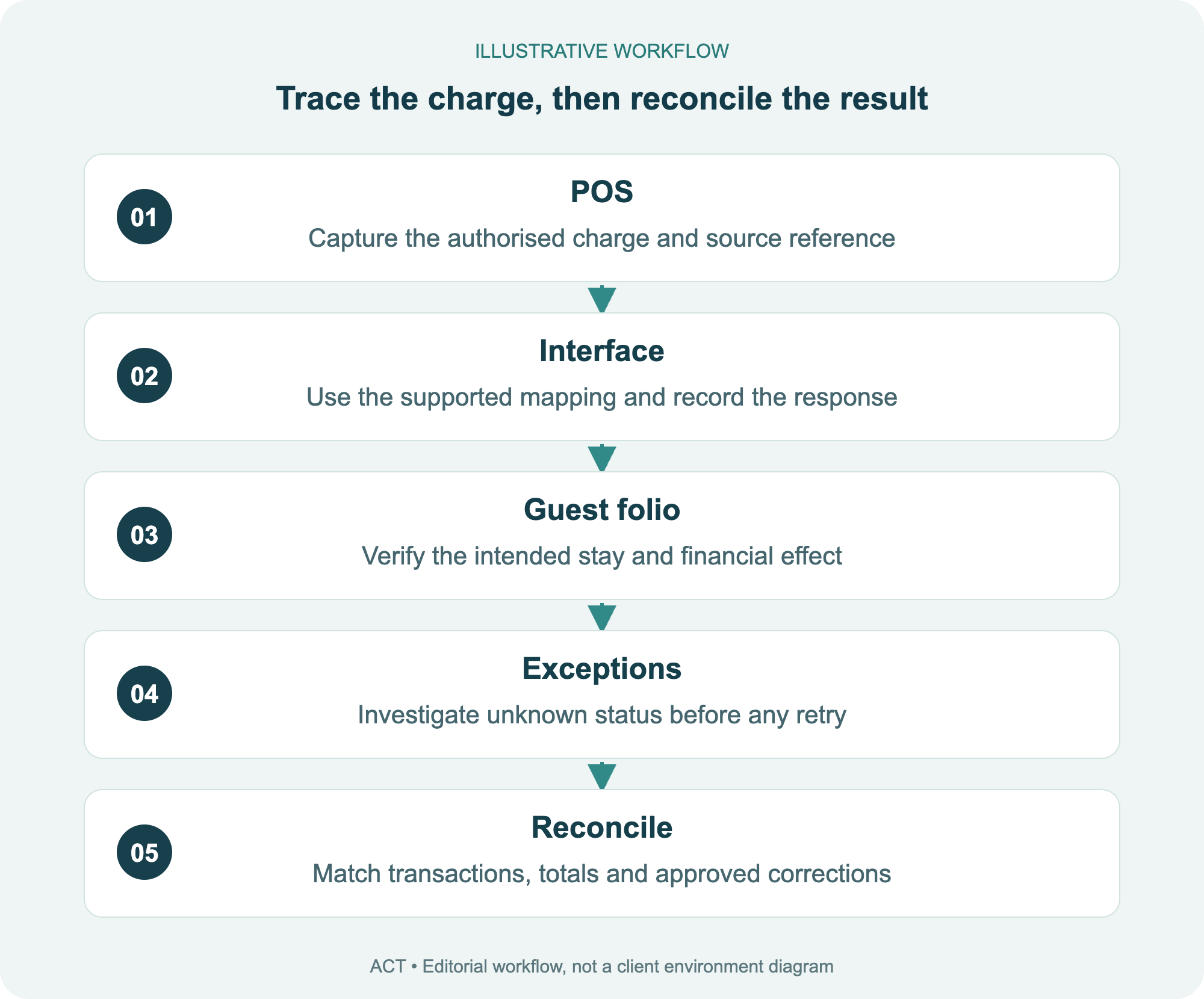
Trace the charge, then reconcile the result.
The diagram describes the business evidence chain. The actual technical route and message handling depend on the supported interface. Keep integrated hospitality IT systems in view when checking connectivity, access and operating dependencies.
Use an eight-scenario acceptance matrix
The following matrix contains simulated teaching outcomes only, not product test results or an ACT customer case. Its example rule permits room charges to eligible in-house stays and does not enable post-checkout charging. Actual tests must record the installed versions, interface configuration and approved hotel rules.
| ID / scenario and precondition | Expected outcome under the example rule | Simulated observation | Acceptance |
|---|---|---|---|
| T01: Normal charge to an eligible stay | One correct posting to the intended account | Correct account and amount recorded once | Pass |
| T02: Charge attempted after checkout with no permitted open account | Reject without an unintended financial posting | Charge rejected; no folio impact | Pass |
| T03: Guest moved to another room | Apply the authorised charge to the correct stay | Correct stay found and charged | Pass |
| T04: Same source transaction attempted twice | No unintended duplicate financial effect; handling follows the supported interface | Duplicate posting observed in the simulation | Hold |
| T05: Approved void or refund of an existing transaction | Supported reversal has the intended financial effect and traceable original reference | Original and reversal reconcile | Pass |
| T06: Connection lost after submission, before clear confirmation | Establish the final status before deciding whether any retry is appropriate | Investigation confirms the charge was already posted | Pass after status confirmation |
| T07: Unsupported or mismatched posting code | Prevent incorrect classification and surface the failure | Request rejected; mapping correction required | Pass for rejection handling; correction remains open |
| T08: Day-end mismatch | Explain and resolve differences across matched populations | POS net total EGP 1,000; PMS total EGP 1,250; duplicate T04 explains EGP 250 | Hold pending approved correction and retest |
The amounts above are invented teaching data. T07 passing its negative test does not approve the incorrect mapping for live use, and T06 does not imply that every product can recover an interrupted request automatically.
Attach evidence and ownership to every result
| Test | Evidence to retain | Investigation or acceptance owner |
|---|---|---|
| T01 | Source reference, response and matching folio entry | F&B lead with finance |
| T02 | Stay status, rejection record and absence of unintended posting | Front office owner |
| T03 | Room-move history, stay reference and final posting | Front office with interface owner |
| T04 | Both attempts, original reference and duplicate folio entries | Interface owner; finance approves correction |
| T05 | Original and reversal references with resulting totals | Finance controller |
| T06 | Submission time, available response logs and verified final account state | Hotel IT with interface support |
| T07 | Source category, mapping version and rejection evidence | Configuration owner with finance |
| T08 | Comparable daily reports and the explained difference register | Finance controller with F&B and IT |
Keep test cases linked to the environment and configuration version. A result without that context may be impossible to reuse after a POS update or a posting-code change. Real acceptance requires observed evidence; the teaching outcomes cannot serve as a signed test record.
Investigate unknown status before correcting it
An interrupted connection can leave the POS uncertain even when the destination has received the charge. Start by locating the transaction through its reference, timestamp and account evidence. Use the interface supplier’s supported investigation and recovery method.
Avoid blind resubmission, manual deletion or an unrelated compensating transaction. These can create a second discrepancy and make the original cause harder to trace. Finance should approve the correction, and the correction should preserve an understandable audit trail within the supported system controls.
For day-end reconciliation, align the business date, property, outlet population, currency and inclusion of voids or refunds. Compare like with like before treating a difference as lost data. A matching aggregate total also does not prove that every individual charge reached the correct guest.
Common integration errors and the acceptance checklist
Common errors include testing only a normal charge, using a room number as the only matching assumption, and correcting a financial discrepancy before understanding its source. Another is assuming that an interface accepted for one revenue center automatically covers every outlet.
Before approval, confirm:
- The product versions and supported interface configuration are recorded.
- Guest, property, posting, amount and date meanings are agreed.
- All eight scenarios have expected outcomes and real evidence.
- Unknown-status handling avoids uncontrolled retries.
- Reversals and corrections are authorised and traceable.
- Finance can reconcile transactions and daily totals.
- Support can obtain the necessary logs without exposing guest data or secrets.
- Retests are defined for affected changes and unresolved defects.
Approval should cover the transaction lifecycle and its operating support, with unresolved limitations visible to the hotel.
Frequently Asked Questions
What should happen when a room charge is attempted for a checked-out guest?
Check the stay and account status against the hotel’s configured rules. Some supported configurations may permit specific post-checkout accounts, while others reject the charge. Staff should verify the authorised destination and follow the exception procedure instead of posting to a different guest to bypass rejection.
How should room moves affect POS-to-PMS posting tests?
Test the supported guest or stay identification after the move, including an attempt using outdated room information. Verify the final account, not only a successful interface response. The test should demonstrate that the charge follows the intended stay under the selected configuration.
How can duplicate room-charge postings be detected during testing?
Correlate the original POS reference, subsequent attempts and resulting account entries. Test the interface’s documented handling of repeats and unknown responses. Do not assume universal idempotency; if duplicate effects can occur, the operating procedure must detect and resolve them without creating further duplicates.
How should voids and refunds be reconciled between POS and PMS?
Match the reversal or refund to the original transaction and confirm the intended net effect in both systems. Check the relevant dates, currency and posting categories. Follow the supported financial correction process and retain the approval and references needed for later reconciliation.
How can staff investigate a room charge whose final status is unknown after a disconnect?
Locate the source request and destination account evidence using the reference and timing available. Ask interface support to establish whether the request was accepted, rejected or remains unresolved. Do not resubmit merely because the POS did not receive a clear confirmation.
Do all restaurant revenue centers need identical posting rules?
No. Different outlets may require different classifications or approved configurations. Document each relevant revenue center and test its actual mapping. Consistent governance is useful, but identical settings should not be imposed when they would misrepresent the hotel’s financial or operating structure.
How should taxes and service charges be mapped for the selected configuration?
Finance should approve how the components are represented, and the implementation team should verify the supported product configuration. Compare source and destination amounts and reporting effects. Do not infer local tax treatment from a generic integration example or copy another property’s setup without review.
How should PMS and POS upgrades with different release schedules be coordinated?
Check the supported compatibility combination before either change, identify the affected interface behaviours and reserve a coordinated test window. Retest the relevant normal and exception cases. Keep a clear version record so support can distinguish a configuration defect from an unsupported release combination.
What evidence helps finance investigate a PMS–POS mismatch at day-end?
Preserve source and destination transaction references, timestamps, business dates, posting codes, currency and relevant reports. First align the populations being compared. Then assign each difference to a specific investigation rather than attempting to make totals agree through an unexplained adjustment.
Which transaction logs should be available to the support team?
Provide the approved diagnostic records needed to correlate requests, responses and posting outcomes, with access controlled by role. Mask or exclude unnecessary guest information, payment details and secrets. Availability of logs and retention periods should be agreed with the hotel and suppliers.
How can staff identify a rejected room charge without reposting it blindly?
Use the status information and error handling supported by the configured interface. Train staff to recognise the rejection, capture the reference and follow the escalation route. If the status is uncertain, investigate it before deciding whether another posting is appropriate.
Which integration tests must be repeated after a posting-code change?
Repeat the affected normal posting, incorrect-code handling, reversal or refund and day-end reconciliation cases. Include each impacted revenue center and any dependent reporting. Finance and the system owners should accept the new mapping before it replaces the previously approved configuration.
Next steps
Agree the transaction map with finance and F&B, then test the normal journey and all relevant exceptions in a controlled environment. Keep acceptance tied to reconciled evidence and a support process that can investigate an uncertain transaction without creating a second problem.
Discuss your hotel PMS and POS integration requirements with ACT.