

Key takeaways
- Audit facility systems and application dependencies together.
- Establish temporary capacity before removing an existing dependency.
- Give every phase an approved window, acceptance gate and stop condition.
- Separate completion of physical work from acceptance of the business service.
Define the services that the project must protect
List the business services using the facility, their owners and their acceptable operating constraints. Include shared identity, network and storage components. A small physical change may affect several applications through a common power path or network connection.
Record the current asset inventory, support status, utilisation and known capacity limits. Then describe the intended result: replacing unsupported equipment, reorganising racks, improving environmental control or creating capacity for growth. A procurement list is not a modernization plan unless it explains how current services will remain controlled during installation.
The implementation partner also needs clear responsibility for coordinating civil works and IT changes. ACT’s guide to choosing a data center solutions provider offers a starting point for that supplier decision.
Audit facility and application dependencies together
Walk through the proposed work with both facilities and IT owners. Check power paths, cooling coverage, rack space, cabling routes, environmental monitoring and physical access. Use qualified specialists to assess electrical, mechanical and fire-protection work; a content checklist cannot establish safe installation procedures.
Pair the facility map with the service dependency map. Identify which applications depend on each rack, switch, storage system or shared utility. Confirm whether apparent redundancy remains independent during the planned work. Two devices do not provide useful resilience if the same activity disables both of their dependencies.
| Approach | When it may fit | Constraint to resolve |
|---|---|---|
| Modernize in place | The facility remains suitable and work can be isolated | Safe access, temporary capacity and controlled service windows |
| Relocate selected equipment | Another supported area can host an affected group | Connectivity, capacity and a tested move sequence |
| Reconsider workload placement | Facility limits conflict with business requirements | Application dependencies and operating implications of a different environment |
Review hybrid IT infrastructure options when workload placement forms part of the decision. Moving workloads elsewhere should have its own acceptance plan, rather than being assumed to remove every facility risk.
Sequence the work into three controlled phases
The following illustrative phase plan is not an ACT project schedule or engineering design. Its example windows are named change slots, not actual dates or guaranteed durations. The project team would approve their timing after assessing the site.
| Phase | Assets and affected services | Prerequisite and temporary arrangement | Change window |
|---|---|---|---|
| P1: Prepare an alternative location | Spare rack capacity, connectivity and monitoring for the application group | Facilities verifies power and cooling headroom; IT validates the temporary network path before relocation | Slot A, before the dependent service move |
| P2: Move and modernize the isolated area | Application group, affected cabling and rack area | Temporary location accepted; qualified teams isolate the agreed work area; power and cooling dependencies remain recorded | Slot B, approved jointly by service owners and facilities |
| P3: Recommission and stabilise | Completed rack area, restored connectivity and operating records | Physical checks complete; the service move back is rehearsed or explicitly excluded from scope | Slot C, after commissioning evidence is accepted |
Temporary capacity needs the same scrutiny as permanent capacity. Confirm its ability to support the actual equipment, workload, environmental conditions and monitoring period. A vacant rack is not proof that power, cooling and network access are sufficient.
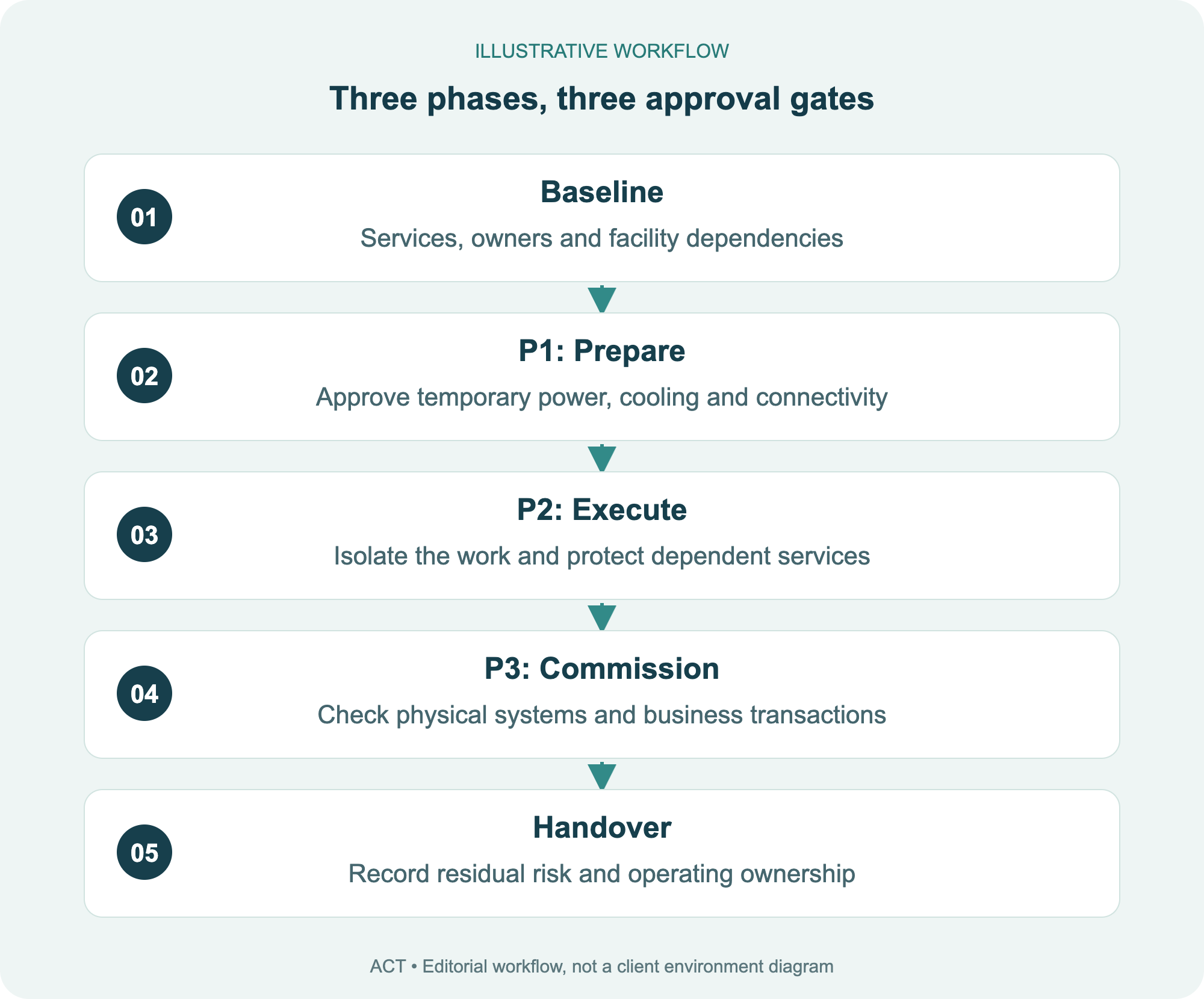
Three phases, three approval gates.
Set an acceptance gate for every phase
Acceptance should identify both the required evidence and who can stop the change. The illustrative gates below connect directly to P1–P3; they describe expected tests, not tests already performed.
| Phase | Acceptance test and evidence | Stop or fallback decision | Owner |
|---|---|---|---|
| P1 | Capacity assessment, environmental readings and a successful connectivity check saved in the change record | Do not relocate equipment if temporary operation cannot be supported | Facilities lead and IT infrastructure owner |
| P2 | Commissioning records for completed works and business transaction checks in the temporary location | Keep the affected work isolated; return services only through an approved, feasible path | Change manager with facilities and service owners |
| P3 | Stable service measurements, updated asset records and signed operational acceptance | Hold closure and resolve the failing criterion; do not assume physical work can be reversed | Service owner and operations lead |
Rollback has practical limits in a renovation. Once equipment is removed or physical work changes the original installation, restoring the previous state may no longer be a simple option. Define a safe fallback for each phase and identify irreversible steps before starting them.
What the published AGIBA case demonstrates
ACT’s AGIBA data center project describes a phased renovation involving civil works, cabling, power and cooling changes. The published account reports 16 controlled downtime events and states that business operations were not adversely affected. That project-specific account does not establish that every modernization can avoid downtime or use the same sequence.
For a new project, the useful lesson is to make the connection between the work window and business acceptance visible. The P1–P3 example above is an editorial model, not a reconstruction of AGIBA’s execution records.
Execute, measure and hand over
- Confirm the approved scope and the current dependency map before opening the window.
- Brief the people executing the work and those receiving incident reports.
- Check prerequisite evidence before moving to a dependent activity.
- Record changes to the plan and obtain approval for expanded impact.
- Measure service behaviour after the phase under a comparable workload.
- Update asset, cabling, configuration and maintenance records before handover.
Compare measurements that answer the project’s objective: capacity headroom, environmental behaviour, relevant service performance and the stability of monitoring. Keep timestamps and measurement conditions so an apparent improvement is not simply a quieter operating period.
ACT’s data center services cover facility capabilities relevant to this work. The specific design, coverage and acceptance criteria still belong in the agreed project scope.
Common sequencing mistakes and readiness checklist
Common mistakes include scheduling IT moves before temporary capacity is accepted, overlooking equipment with undocumented connections, and treating contractor completion as service acceptance. Another is allowing the facilities and IT teams to keep different versions of the same change plan.
Before each phase, confirm:
- The affected assets and dependent services are identified.
- Power, cooling, connectivity and physical access have responsible owners.
- Temporary arrangements have evidence of suitability.
- Business owners have approved the expected impact and window.
- Commissioning and business acceptance tests are separate and explicit.
- Stop conditions reflect the point reached in the physical work.
- Records, unresolved issues and operating responsibilities are ready for handover.
If the facility cannot support a workable sequence or temporary arrangement, revisit the scope. Forcing an in-place upgrade into an unsuitable environment can increase risk instead of resolving it.
Frequently Asked Questions
How should assets with expired vendor support be prioritized?
Prioritise them by the consequence of failure, replacement options and dependencies, not age alone. A lightly used unsupported device may still sit on a critical shared path. Record the owner’s accepted interim risk and the condition that will trigger replacement.
How should rack density influence modernization priorities?
Assess the proposed equipment load against the power and cooling available to that rack and its surrounding area. Use site measurements and specialist design input. A general density figure cannot establish whether a specific location is suitable for additional equipment.
Can cabling be replaced without moving every workload?
Sometimes, if the affected connections can be isolated and an alternative path is verified. Map both ends of each connection and test the intended service sequence. Do not assume that unused-looking cables or redundant-looking links can be removed without validation.
What temporary power and cooling arrangements may be needed?
The answer depends on the work area, equipment and duration. Facilities specialists should establish the required capacity, safe installation, environmental monitoring and contingency arrangements. Include the temporary setup in acceptance; it should not remain an undocumented exception to the project design.
What should happen when two departments cannot agree on a change window?
Escalate the business conflict to the agreed change authority with the impact of each option. Record the decision and communication plan. An IT-selected window is not sufficient when the activity also affects finance processing, customer operations or facilities access.
How should undocumented legacy hardware dependencies be handled?
Pause the affected decision and investigate with configuration records, physical inspection and operational owners. Label uncertainty explicitly. If the dependency cannot be established, agree additional discovery or a revised scope rather than allowing the execution team to discover it during removal.
When is refurbishment more appropriate than relocation?
Refurbishment may fit when the facility remains suitable and the work can be sequenced within accepted risk and capacity limits. Relocation may be more practical where physical constraints remain unresolved. Compare the full service transition, not only construction or equipment costs.
Can a partially completed modernization phase be handed back to operations?
Only with a defined operating boundary and formal acceptance of what remains unfinished. Record temporary configurations, restrictions, residual risks and responsibility for completing the work. A partial handover must not make an incomplete phase appear fully commissioned.
Which records must be updated after equipment is replaced?
Update asset identifiers, rack positions, cable schedules, diagrams, configurations, support records and maintenance instructions relevant to the change. Connect these records to the approved change and acceptance evidence so support staff can trace what was replaced and why.
How can facilities and IT teams coordinate the final handover?
Use one shared handover record with distinct facility and service acceptance sections. Confirm who owns monitoring, maintenance, incident escalation and remaining defects. A joint review is especially useful when an environmental condition can affect application availability.
What distinguishes planned downtime from business disruption?
Planned downtime is an approved technical unavailability window; business disruption is its effect on operations. The relationship depends on scheduling, alternatives and service use. A project reporting no adverse business impact does not mean that no technical downtime occurred.
Which measurements should be compared before and after each upgrade phase?
Compare measurements tied to the objective, such as available capacity, environmental conditions and relevant service behaviour. Keep the measurement location, timestamps and load conditions consistent. Explain differences in operating conditions before attributing a change to the upgrade.
Next steps
Start by connecting one proposed physical change to its dependent services and acceptance owners. That exercise will show whether the project needs additional discovery, temporary capacity or a different phase sequence before work is scheduled.